Is Your Dog Overweight? The 10-Second “Rib Test” That Could Save Your Pet’s Life
According to the Association for Pet Obesity Prevention (APOP), nearly 56% of dogs in the United States are classified as overweight or obese. Perhaps more startling is the “Fat Gap”—a phenomenon where pet owners perceive their overweight dogs as being at a normal, healthy weight.
If you aren’t sure where your dog stands, there is one simple, non-invasive, and incredibly accurate method you can use right now: The Rib Test.
In this comprehensive guide, we will dive deep into how to perform the Rib Test, why canine obesity is more dangerous than you think, and how you can add up to two years to your dog’s life by managing their waistline.
What is the Dog Rib Test?
The Rib Test is a hands-on assessment tool used by veterinarians and canine professionals to determine a dog’s Body Condition Score (BCS). Unlike a scale, which only gives you a number in pounds or kilograms, the Rib Test tells you about the composition of your dog’s body.
Because muscle is denser than fat, and because different breeds have vastly different “ideal” weights, a scale can often be misleading. The Rib Test focuses on what is happening underneath the fur and skin.
How to Perform the Rib Test: A Step-by-Step Guide
You don’t need any special equipment to do this—just your hands and a few seconds of your time.
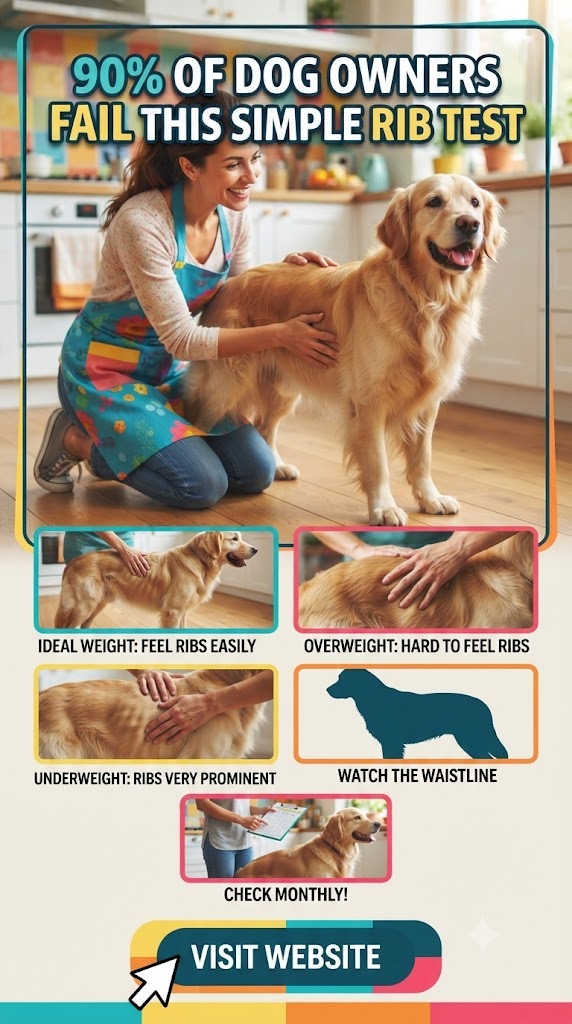
- The Standing Position: Ensure your dog is standing squarely on all four legs. If they are sitting or lying down, their skin and fat deposits will shift, giving you an inaccurate reading.
- The Sides: Place your palms on either side of your dog’s ribcage.
- The Movement: Run your hands gently along the ribs from the shoulders toward the hips. Use light pressure, similar to the pressure you would use to pet them.
- The Assessment: You are looking for a specific sensation.
The “Knuckle Trick”: Decoding the Results
If you aren’t sure what you’re feeling, use your own hand as a reference point. This is the easiest way to understand the Rib Test:
- Underweight (The Knuckles): Make a fist. Run your fingers over your knuckles. If your dog’s ribs feel like this—prominent, bony, and with no fat covering—they are likely underweight.
- Overweight (The Palm): Look at the palm of your hand. Feel the fleshy part at the base of your thumb. If your dog’s ribs feel like this—meaning you have to press firmly to even find a bone—they are overweight or obese.
- Ideal Weight (The Back of the Hand): Lay your hand flat and feel your knuckles from the back of your hand. You can feel the bones easily, but there is a thin layer of skin and tissue over them. This is exactly how a healthy dog’s ribs should feel.
Beyond the Ribs: The Visual Body Condition Score (BCS)
While the Rib Test is the gold standard for tactile assessment, you should also look for visual cues. Veterinarians use a 1–9 scale to grade a dog’s body condition. Here is how to read your dog’s silhouette.
1. The “Hourglass” View (From Above)
Stand over your dog and look down at their back.
- Ideal: You should see a clear “waist” or an inward curve behind the ribs.
- Overweight: The body looks like a rectangle or an oval.
- Obese: The area behind the ribs actually bulges outward.
2. The “Tummy Tuck” (From the Side)
Squat down so you are at eye level with your dog’s profile.
- Ideal: The abdomen should slope upward from the end of the ribcage toward the hind legs. This is known as the “abdominal tuck.”
- Overweight: The underline is flat, parallel to the ground.
- Obese: The belly hangs down, sometimes lower than the ribcage.
Why “A Little Extra” is a Big Problem
Many owners think a “chunky” dog is cute. We call them “chonky,” “fluffy,” or “well-fed.” However, fat is not just an inert layer of insulation. Science has revealed that adipose tissue (fat) is an active endocrine organ.
The Inflammation Factory
Fat cells secrete pro-inflammatory hormones called adipokines. When a dog is overweight, their body is in a constant state of low-grade chronic inflammation. This inflammation attacks the joints, damages internal organs, and weakens the immune system.
The Health Risks of Canine Obesity
- Osteoarthritis: This is the most common consequence. The extra weight puts physical stress on joints, while the inflammation mentioned above actively destroys cartilage.
- Type 2 Diabetes: While less common in dogs than cats, obesity can lead to insulin resistance.
- Hypertension and Heart Disease: The heart has to work significantly harder to pump blood through the excess tissue.
- Respiratory Issues: Fat deposits in the chest and neck can make breathing difficult, leading to exercise intolerance and increased snoring.
- Reduced Lifespan: A landmark 14-year study by Purina found that dogs kept at an ideal weight lived 1.8 to 2 years longer than their overweight counterparts. In “dog years,” that’s a massive amount of time.
Why Did My Dog Get Overweight? (It’s Not Just Food)
Understanding why the weight crept on is essential for taking it off. It is rarely just one thing; it is usually a combination of factors.
1. Portion Distortion
Most pet owners rely on the “cup” that comes inside the bag of kibble or a random plastic cup from the kitchen. These are often inaccurate. Furthermore, the feeding guidelines on the back of the bag are usually based on intact, active adult dogs. If your dog is spayed/neutered or a couch potato, those guidelines are likely 20-30% too high.
2. The “Treat” Trap
A single “Milkbone” or a slice of cheese might seem small to us, but for a 20-pound dog, it can represent 10% of their daily caloric needs. If you give five of those a day, you’ve essentially fed them a second dinner.
3. Slower Metabolism (Spaying and Neutering)
While spaying and neutering are responsible choices for pet population control, these procedures change a dog’s hormonal profile, often slowing their metabolic rate. Owners often fail to adjust food intake after the procedure.
4. Genetic Predisposition
Some breeds are genetically programmed to be “food obsessed.” Labradors, for example, often have a mutation in the POMC gene which controls hunger, making them feel perpetually starving even when they’ve just eaten.
Breed Exceptions: When the Rib Test Varies
While the Rib Test is universal, some breeds have unique skeletal structures that can confuse owners.
- Sighthounds (Greyhounds, Whippets, Salukis): In these breeds, it is actually normal to see the last two or three ribs. If you can’t see ribs on a Greyhound, they are likely overweight.
- Deep-Chested Breeds (Boxers, Dobermans): These dogs have a very dramatic abdominal tuck. Their waist will look much thinner than a Bulldog’s, even at the same BCS.
- Double-Coated Breeds (Huskies, Newfoundlands): The Rib Test is crucial here because you cannot see their body shape through the thick fur. You must use your hands to feel past the “floof.”
The Road to Recovery: How to Help Your Dog Lose Weight
If the Rib Test revealed that your dog is carrying extra weight, don’t panic. Weight loss for dogs is much easier than it is for humans because you control their entire environment.
1. Consult Your Veterinarian First
Before starting a diet, rule out medical issues like hypothyroidism or Cushing’s Disease, which can cause weight gain. Your vet can also calculate your dog’s Resting Energy Requirement (RER) to give you a specific calorie count.
2. Ditch the Measuring Cup; Use a Scale
Measure your dog’s food in grams. It is the only way to ensure consistency. A “level cup” can vary by 20% depending on how the kibble settles.
3. The “Green Bean” Trick
If your dog acts like they are starving on their new, smaller portions, replace 10-20% of their kibble with canned, no-salt-added green beans. This adds volume and fiber to the meal, making them feel full without adding significant calories.
4. Increase “Low-Impact” Exercise
Don’t take an obese dog for a 5-mile run on day one; you’ll blow out their ACLs. Start with:
- Longer, slow walks.
- Swimming (excellent for joint-friendly cardio).
- Interactive feeding (using puzzle toys so they “work” for their food).
5. Rethink the Treats
Instead of processed biscuits, try:
- Blueberries.
- Cucumber slices.
- Carrot sticks.
- Ice cubes (some dogs love the crunch!).
Monitoring Progress
Weight loss in dogs should be slow and steady. Aim for a loss of 1% to 2% of their total body weight per week. For a 50-pound dog, that’s only 0.5 to 1 pound.
Perform the Rib Test every Sunday morning. Keep a log. As the fat melts away, you will notice your dog’s energy levels skyrocket. They will be more playful, less winded, and their coat may even become shinier as the internal inflammation subsides.
Conclusion: A Healthier Future Starts Today
The Rib Test is more than just a physical check-up; it’s a commitment to your dog’s longevity. We want our companions to be with us for as long as possible, and maintaining a healthy weight is the single most effective way to ensure that happens.
Put this article down, find your dog, and feel those ribs. If they are hidden under a layer of “love,” today is the perfect day to start the journey back to health. Your dog doesn’t need that extra treat—they need more years of walks, belly rubs, and life with you.
Is your dog’s Rib Test passing? If not, what’s your first step toward a healthier weight? Share this guide with a fellow pet owner to help spread awareness about the canine obesity epidemic.