Is Your Dog Overweight? The Rib Test (With Picture Guide)
It is a quiet epidemic sweeping across our living rooms, backyards, and dog parks. According to the Association for Pet Obesity Prevention, nearly 60% of dogs in the United States are classified as overweight or obese. Yet, when asked, the vast majority of pet parents believe their dog is at a “normal” weight.
This disconnect is known as the “Fat Pet Gap.” Because we see our dogs every day, and because we often associate food with love, we might not notice the slow creep of extra pounds. However, those extra pounds are more than just “fluff”—they are a significant health risk that can shave years off your best friend’s life.
How can you tell if your dog has crossed the line from “cuddly” to “overweight”? You don’t need a fancy scale or a veterinary degree. You just need your hands. This is where The Rib Test comes in.
Why Weight Matters: The Hidden Dangers of Canine Obesity
Before we dive into the “how-to” of the Rib Test, it is vital to understand why we are doing this. Obesity in dogs isn’t just a cosmetic issue; it is a chronic, low-level inflammatory state.
Fat tissue (adipose tissue) is biologically active. It secretes hormones and inflammatory proteins that put constant stress on your dog’s internal organs. Carrying excess weight leads to:
- Osteoarthritis: Extra weight puts immense pressure on joints, leading to cartilage breakdown and chronic pain.
- Type 2 Diabetes: Overweight dogs can become resistant to insulin.
- Cardiovascular Disease: The heart has to work significantly harder to pump blood through a larger body.
- Respiratory Distress: Fat deposits around the chest and neck can make breathing difficult, especially in “flat-faced” (brachycephalic) breeds like Pugs or Bulldogs.
- Reduced Lifespan: A landmark study by Purina found that lean dogs live, on average, 1.8 to 2 years longer than their overweight counterparts.
Understanding the Rib Test is the first step in reclaiming those two years of life for your dog.
The Rib Test: A Step-by-Step Guide
The Rib Test is the most reliable way for a dog owner to assess their pet’s body condition at home. While a scale gives you a number, the Rib Test gives you a context. A 30-pound Beagle might be obese, while a 30-pound Whippet might be perfectly lean.
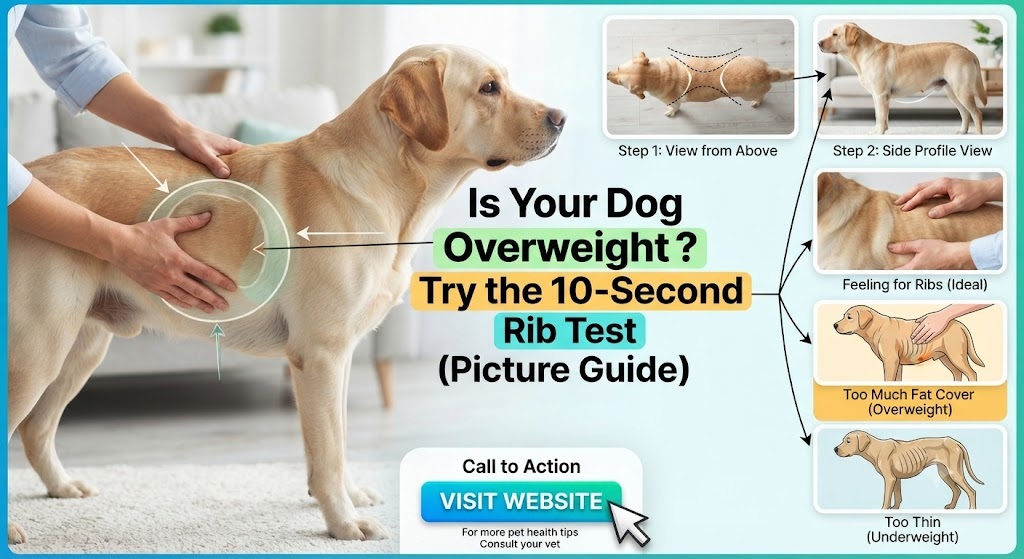
Step 1: The “Feel” Test (The Hands-On Approach)
Stand your dog in a relaxed, neutral position. Do not do this while they are sitting or lying down, as body fat shifts and can give an inaccurate reading.
- Place both of your thumbs on your dog’s spine.
- Spread your fingers across the ribcage.
- Apply very light pressure—the same amount of pressure you would use to feel the keys on a keyboard.
What you are looking for: You should be able to feel each individual rib easily under a thin layer of skin and fat.
Step 2: The “Hand Comparison” Trick
If you aren’t sure what you’re feeling, use your own hand as a guide. This is a classic veterinary trick to help owners understand body condition:
- Underweight (The Knuckle Test): Make a fist. Run your fingers over your knuckles. If your dog’s ribs feel like your knuckles—hard, bony, and prominent—your dog is likely underweight.
- Ideal Weight (The Finger Test): Keep your hand flat, palm down. Run your fingers over the back of your hand (where your metacarpal bones are). If your dog’s ribs feel like this—detectable but covered by a small layer of padding—they are at an ideal weight.
- Overweight (The Palm Test): Turn your hand over and feel your palm, specifically the fleshy part under your thumb. If your dog’s ribs feel like this—soft, squishy, and impossible to find without pressing hard—your dog is overweight or obese.
The Visual Guide: The Body Condition Score (BCS)
Vets use a system called the Body Condition Score (BCS), usually on a scale of 1 to 9. Think of this as the “Picture Guide” for your dog’s health.
Score 1–3: Too Thin (Underweight)
- The Ribs: Very prominent; no fat cover.
- The Profile: From the side, the abdomen is tucked up extremely high.
- The Overhead View: The waist is very narrow, and the “wings” of the pelvis (hip bones) are sticking out.
- Action: Consult a vet. This could indicate underfeeding or an underlying medical issue like parasites or malabsorption.
Score 4–5: The Gold Standard (Ideal)
- The Ribs: Easily palpable with minimal fat covering.
- The Profile: You should see a clear “abdominal tuck.” The belly should slope upward from the end of the ribcage to the hind legs.
- The Overhead View: Your dog should have a noticeable waistline behind the ribs, creating an hourglass shape.
- Action: Maintain this! You are doing a great job with diet and exercise.
Score 6–7: Overweight
- The Ribs: Difficult to feel; you have to press down to find them.
- The Profile: The abdominal tuck is slight or non-existent. The underline of the dog is almost a straight line.
- The Overhead View: The waist is barely visible. The back looks broad and flat.
- Action: It’s time to cut back on treats and increase daily walks.
Score 8–9: Obese
- The Ribs: Impossible to feel under a thick layer of fat.
- The Profile: No abdominal tuck. In some cases, the belly may actually bulge downward (the “pendulous” abdomen).
- The Overhead View: The waist is gone. The area behind the ribs might even bulge outward, creating an “oval” or “lightbulb” shape.
- Action: This is a medical emergency. Obesity at this level significantly increases the risk of sudden heart failure and heatstroke.
Beyond the Ribs: Other Signs Your Dog Is Carrying Too Much Weight
While the Rib Test is the “Gold Standard,” there are other behavioral and physical cues that indicate your dog needs to shed some pounds.
1. The “Waddle” vs. The “Trot”
Watch your dog walk from behind. An ideal-weight dog has a rhythmic, clean gait. An overweight dog often develops a “waddle,” where their rear end sways significantly from side to side because their thighs are rubbing together or their core strength is compromised by abdominal fat.
2. Difficulty Grooming
Can your dog still reach their back end to scratch or clean themselves? Overweight dogs often lose the flexibility required for basic grooming. If you notice your dog “giving up” halfway through a scratch, it might be because their stomach is getting in the way.
3. Excessive Panting
Does your dog start panting after a short walk to the mailbox? Does it take them a long time to catch their breath after playing? Fat acts as an insulator, making it harder for dogs to regulate their body temperature. Furthermore, the extra weight makes every movement require more oxygen.
4. Reluctance to Move
If your dog used to jump onto the couch or run to the door but now hesitates or requires a “boost,” it may not just be old age. It may be that the “cost of transport” for their body has become too high.
Why Is My Dog Overweight? Common Culprits
Understanding how your dog got overweight is essential to fixing the problem. It is rarely just one thing; usually, it’s a combination of lifestyle factors.
The “Treat” Trap
Many owners don’t realize that a single “human” treat can be a caloric bomb for a dog.
- One ounce of cheddar cheese for a 20-pound dog is the caloric equivalent of two and a half cheeseburgers for a human.
- A single peanut butter cracker is like a whole slice of pizza for a small breed. Treats should never make up more than 10% of a dog’s daily caloric intake.
The “Eyeball” Method of Feeding
Using a random plastic cup or “eyeballing” the scoop is a recipe for weight gain. A “cup” of dog food is a standard 8-ounce measuring cup. If you use a large 12-ounce coffee mug to scoop, you are overfeeding by 50% every single day.
Low-Quality Fillers
Inexpensive dog foods are often packed with carbohydrates and fillers (corn, wheat, soy) that provide “empty” calories. These foods might keep a dog full momentarily, but they spike insulin levels, which encourages the body to store fat.
Biological Factors
- Spaying/Neutering: Fixing a dog changes their hormone profile and can slow their metabolism by about 20%. Owners often fail to adjust food portions after the procedure.
- Breed Predisposition: Some breeds, like Labrador Retrievers, Beagles, and Golden Retrievers, are genetically wired to be “food motivated” and store fat more easily.
- Age: Just like humans, a dog’s metabolism slows as they age. A senior dog cannot eat the same amount of food they did as a two-year-old.
How to Help Your Dog Lose Weight Safely
If your Rib Test resulted in a “Palm” feel (Overweight/Obese), don’t panic. Weight loss for dogs is highly achievable, but it must be done carefully. Never put your dog on a “crash diet,” as rapid weight loss can lead to liver issues (especially in cats, but dogs are also at risk for metabolic stress).
1. Consult Your Veterinarian First
Before starting any diet, you must rule out medical causes for weight gain. Conditions like Hypothyroidism or Cushing’s Disease can cause a dog to gain weight even if they are eating very little. If a medical issue is present, no amount of exercise will fix the weight until the condition is managed.
2. Switch to a Gram Scale
Stop measuring by volume and start measuring by weight. Using a digital kitchen scale to weigh your dog’s food in grams ensures 100% accuracy. Even an extra 10 grams of kibble a day can lead to a pound of weight gain over a year for a small dog.
3. The “Green Bean” Trick
If your dog is acting hungry on their new, reduced-calorie diet, you can bulk up their meals with fiber. Canned (no-salt-added) or frozen green beans are low in calories but high in volume. They help the dog feel full without adding to the fat stores.
4. Interactive Feeding
Instead of using a bowl, use a puzzle toy or a Snuffle Mat. This slows down their eating and turns mealtime into a calorie-burning activity. Making your dog “work” for their food provides mental stimulation and burns off extra energy.
5. Increased, Low-Impact Exercise
Don’t take an obese dog for a 5-mile run on the first day. This will lead to blown out ACLs or heatstroke. Start with:
- Slow, consistent walks: 15 minutes, twice a day, on soft surfaces like grass.
- Swimming: This is the best exercise for overweight dogs because it is zero-impact on the joints.
- Indoor “Hide and Seek”: Hide small pieces of their kibble around the house to keep them moving.
6. Track Progress with Photos
Because you see your dog every day, you won’t notice the changes. Take a photo from the “Overhead” and “Profile” views every two weeks. When you compare month one to month three, the difference in the Rib Test and the visual tuck will be your biggest motivation.
Breed-Specific Considerations: Not All Ribs Are Created Equal
It is important to note that the Rib Test has some nuances based on the breed of your dog.
- Sighthounds (Greyhounds, Whippets, Salukis): These dogs are naturally very lean. For these breeds, it is actually normal to see the faint outline of the last two or three ribs even when they are at an ideal weight. If you can’t see the ribs on a Greyhound, they are likely overweight.
- Deep-Chested Breeds (Boxers, Dobermans): These dogs have a very dramatic abdominal tuck. Their “waist” might look extreme to owners of other breeds, but it is their healthy natural silhouette.
- Heavy-Coated Breeds (Bernese Mountain Dogs, Newfoundlands, Poodles): You cannot rely on a visual test for these dogs. Their fur hides everything. For “floofy” dogs, the Hands-On Rib Test is the only way to accurately assess weight. You must dig your fingers through the coat to find the ribs.
The Psychology of the “Treat”: Changing Your Mindset
As dog owners, we have been conditioned to believe that a treat equals love. When our dog looks at us with those “puppy dog eyes,” our instinct is to reach for the cookie jar.
To help your dog lose weight, you must redefine your “Reward System.”
- The Reward of Attention: Most dogs value a 5-minute session of belly rubs or playing with a squeaky toy just as much as a treat.
- The Reward of “Air”: Instead of a treat, take your dog outside for a quick sniff-session in the yard.
- The “Tiny Piece” Rule: If you must give a treat, break it into the smallest possible pieces. A dog doesn’t care about the size of the treat; they care about the act of receiving it. One medium milk-bone broken into four pieces is four “rewards” for the price of one.
Conclusion: A Lean Dog is a Happy Dog
Performing the Rib Test once a month is one of the simplest and most effective things you can do to ensure your dog’s longevity. It takes thirty seconds, costs nothing, and provides you with the data you need to make life-saving decisions for your pet.
Remember: You are the gatekeeper of your dog’s health. They cannot open the fridge, and they cannot choose to go for a walk on their own. By keeping your dog at an ideal weight, you aren’t “depriving” them of treats—you are giving them the gift of less pain, more energy, and more years by your side.
Put your hands on your dog’s ribs today. What do they tell you? If it’s time for a change, start today. Your dog’s future self will thank you for it.